
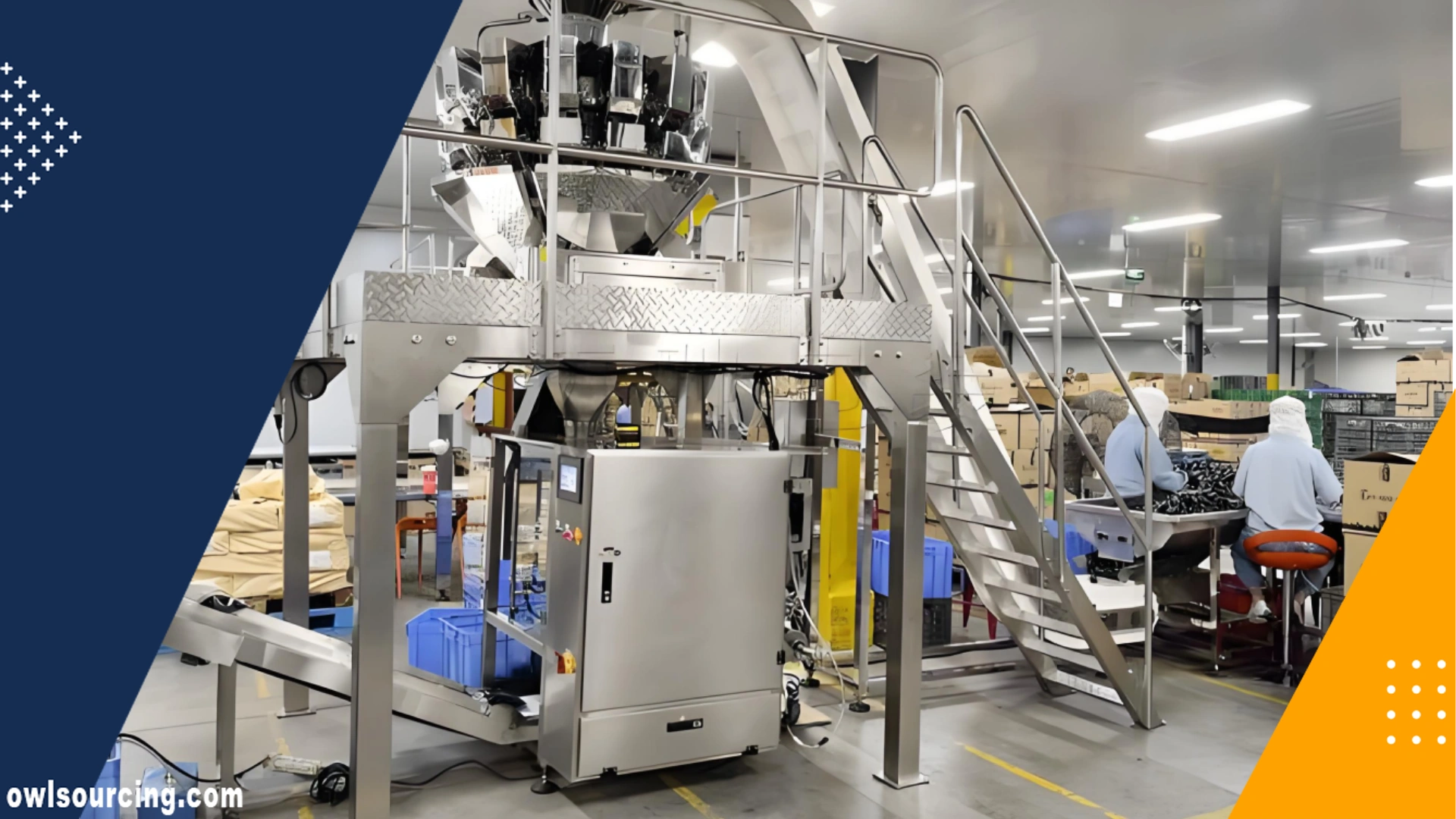

An automatic packaging machine is a sophisticated automated system that handles product filling, forming, sealing, and labeling with minimal human intervention. These machines dramatically improve production efficiency, accuracy, and consistency compared to manual processes.
Key benefits include:
- Boosted output speeds (often 5-10x faster)
- Reduced labor costs
- Enhanced product safety
- Lower waste
Sourcing from China provides major advantages:
- 40-70% cost savings versus Western equivalents
- Vast selection of machine types
- Extensive customization options
- Rapid adoption of technologies like PLC controls, servo motors, and IoT integration
Pricing typically ranges from $5,000–$15,000 for small/entry-level models to $50,000–$200,000+ for advanced full lines.
Partnering with a professional sourcing agent like OwlSourcing eliminates common risks—such as poor quality, delays, or unreliable suppliers—through expert factory audits, quality inspections, negotiation, and logistics support.
In this comprehensive guide, we will delve into everything you need to know about automatic packaging machines from China—what they are, how they work, the different types available, and much more. Let’s get started!
What Is an Automatic Packaging Machine?
Automatic packaging machines represent a cornerstone of modern manufacturing, automating the entire process of preparing products for distribution. These systems integrate mechanical, electrical, and software components to perform tasks that once required extensive manual labour.
At their core, automatic packaging machines take raw materials (films, pouches, bottles, or cartons), fill them with products (granules, liquids, powders, or solids), seal them securely, and often apply labels or codes. Advanced models incorporate weighing systems, vision inspection, and rejection mechanisms for defective packages.
The evolution of these machines traces back to early 20th-century semi-automatic fillers, but today’s versions are fully automated, controlled by programmable logic controllers (PLCs) and human-machine interfaces (HMIs). They handle speeds from 30 packages per minute for basic models to over 500 for high-end lines.
Common applications span industries: food (snacks, beverages), pharmaceuticals (blister packs), cosmetics (creams, lotions), chemicals (powders, granules), and e-commerce fulfilment (mixed products).
For businesses, investing in these machines means shifting from labour-intensive operations to scalable, consistent production. A mid-sized food company, for example, might replace 10 manual packers with one vertical form-fill-seal (VFFS) machine, achieving consistent portion control and reducing contamination risks.
In China, manufacturers have refined these systems to balance affordability with reliability, incorporating stainless steel construction (often 304 or 316 grade for food/pharma compliance) and branded components from global leaders like Siemens or Schneider.
How Do Automatic Packaging Machines Work?
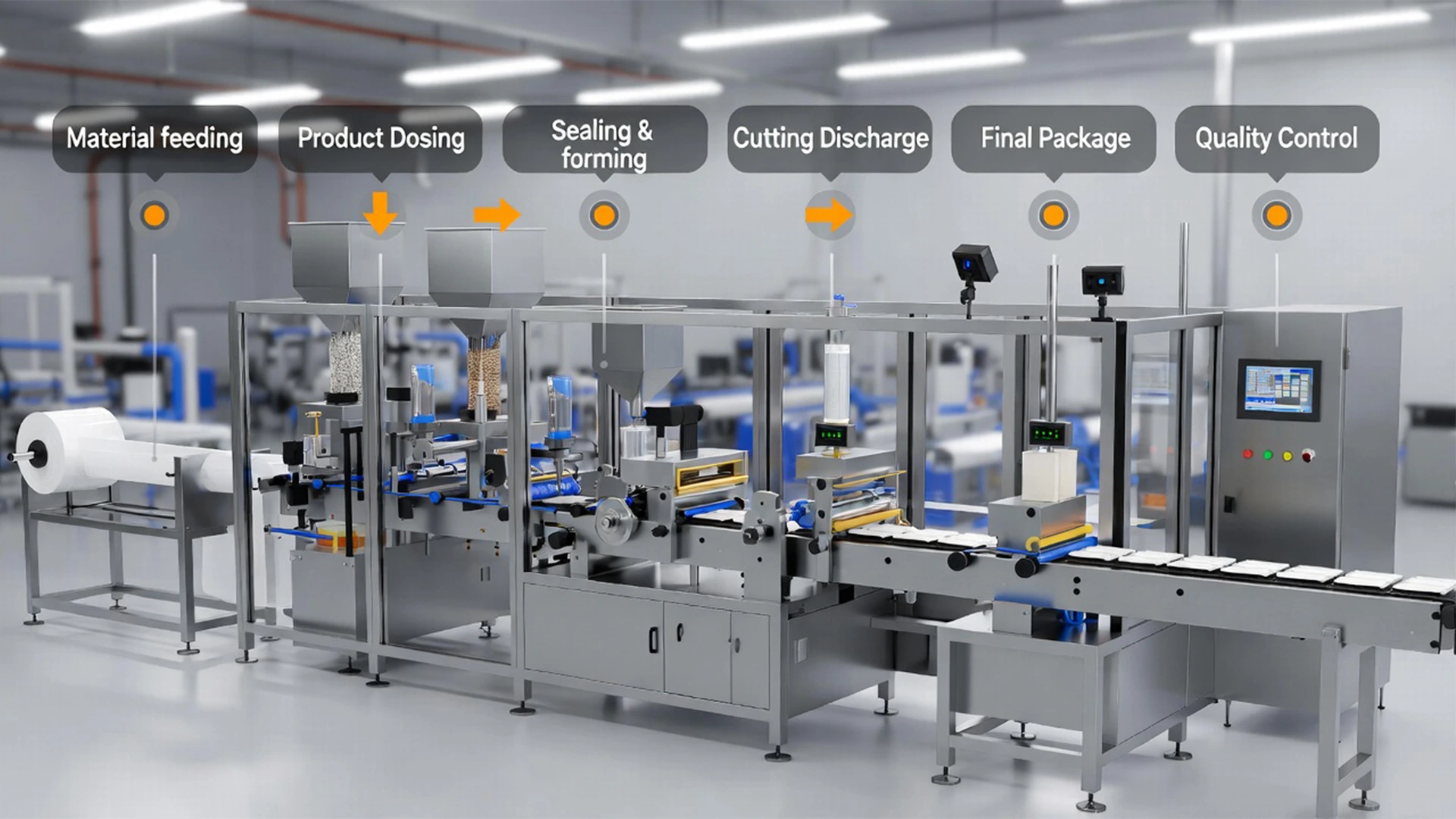
Understanding the workflow helps buyers appreciate the technology and specify requirements accurately.
Most automatic packaging machines follow a sequential process:
- Material Feeding — Packaging material (film roll, pre-made bags, or containers) loads automatically. For VFFS machines, film unwinds and forms into a tube around a forming collar.
- Product Dosing/Filling — Products dispense precisely. Granules use multi-head weighers; liquids employ piston or peristaltic pumps; powders rely on auger fillers.
- Sealing and Forming — Heat sealers or ultrasonic welders create airtight seals. Vertical and horizontal jaws close simultaneously for efficiency.
- Cutting and Discharge — Packages separate and convey out for secondary operations like labeling or cartoning.
- Quality Checks — Sensors detect fill levels, seal integrity, or metal contaminants, rejecting faults automatically.
Modern machines integrate IoT for real-time monitoring, predictive maintenance, and data logging. Changeovers between products take minutes thanks to tool-less adjustments.
Expert Advice: Please often recommend requesting demo videos from suppliers using your actual product—this reveals real-world performance that specifications alone cannot. So video is best.
What Are the Key Benefits of Automatic Packaging Machines?
Switching to automation delivers transformative advantages. Here’s a detailed breakdown:
| Benefit | Description | Real-World Impact |
| Increased Speed | 100-500+ packages/min vs. manual 20-50 | Scale production without proportional staff increases |
| Labor Savings | Reduce workforce by 60-80% | Redirect labour to higher-value tasks |
| Consistency & Accuracy | Precise filling (±0.5-2% tolerance) | Minimise overfills/underfills and customer complaints |
| Hygiene & Safety | Enclosed systems, stainless steel | Meet FDA/EU standards, reduce contamination |
| Waste Reduction | Optimised material use, fewer errors | Cut packaging costs by 10-30% |
| Flexibility | Quick format changeovers | Handle seasonal or multi-product lines |
| Data & Traceability | Integrated tracking | Improve inventory and recall management |
For a startup, automation eliminated manual weighing errors that caused 5% product loss. Larger operations benefit from 24/7 runtime capability.
Chinese machines deliver these benefits at a lower cost without sacrificing core features, often including free installation training.
Types of Automatic Packaging Machines from China
China offers a wide and diverse range of automatic packaging machines from China to meet virtually every industry need, from high-volume food production to small-batch e-commerce operations.
A. Food and Granule Packaging Machines
Vertical Form Fill Seal (VFFS) systems are the most popular choice for packaging dry food products such as snacks, rice, nuts, seeds, coffee beans, candy, pet food, and frozen vegetables. These machines form bags directly from a roll of film, fill them with product, and seal them in one continuous motion. Multi-head weighers (commonly 10–14 heads) provide high accuracy (±0.5–1 g) even at speeds of 60–150 packs per minute, reducing product giveaway and ensuring compliance with weight labelling regulations. Many models include options for nitrogen gas flushing to extend shelf life and prevent oxidation, as well as easy-change forming tubes for different bag sizes (pillow, gusset, quad-seal, stand-up pouches). For businesses handling mixed snacks or trail mixes, combination weighers with memory bucket functions minimize breakage of fragile items.
B. Vacuum and Sealing Packaging Machines
Vacuum packaging is essential for extending shelf life and preserving the freshness of perishable goods like fresh or frozen meats, seafood, cheese, deli products, and ready-to-eat meals. Chamber vacuum machines are ideal for smaller operations: operators place filled bags inside a sealed chamber, the machine removes air, and then applies a strong heat seal. Inline or external vacuum sealers, often integrated with VFFS or HFFS lines, are used for higher throughput. These systems can achieve residual oxygen levels below 1%, significantly slowing bacterial growth and rancidity. Advanced models offer MAP (Modified Atmosphere Packaging) with gas mixtures (nitrogen + CO₂) to maintain product color and texture. Double-chamber designs allow continuous operation, boosting efficiency for mid-size food processors.
C. Liquid Filling and Packaging Machines
Liquid and semi-liquid products—sauces, oils, honey, beverages, dairy, cosmetics, and chemicals—are typically handled by piston fillers, gravity fillers, or flow-meter systems. Piston fillers excel at thick, viscous products (ketchup, mayonnaise, pastes) because they deliver precise volumetric shots without foaming or dripping. Gravity fillers work well for thinner, free-flowing liquids (water, juices, oils), while flow-meter or mass-flow technologies provide the highest accuracy for expensive or regulated products. Many machines are paired with rotary premade pouch fillers or bottle/cup filling lines, featuring anti-drip nozzles, diving nozzles to reduce splashing, and CIP (Clean-in-Place) systems for quick sanitation. Speeds range from 30–120 packs/minute, depending on viscosity and container type.
D. Weighing and Precision Packaging Machines
When exact weight control is critical—especially for mixed, fragile, sticky, or irregularly shaped products—combination multi-head weighers or linear weighers are the go-to solution. These systems use vibration feeders and load cells to achieve exceptional accuracy (±0.1–1 g) at high speeds. They are commonly integrated with VFFS, HFFS, or rotary pouch machines for snacks, frozen foods, hardware, candies, dried fruits, and small plastic parts. Features like anti-stick coatings, gentle discharge chutes, and auto-zeroing help handle delicate or sticky items without clumping or damage. For ultra-precise applications, some models include check-weighers and metal detectors downstream to ensure final package compliance.
E. Pharmaceutical and Speciality Packaging Machines
Pharmaceutical packaging demands strict compliance with GMP, cGMP, and cleanroom standards. Blister packaging lines (thermoforming + filling + sealing), strip packing machines, vial/bottle filling and capping lines, and cartoning systems are widely used for tablets, capsules, softgels, syrups, injectables, and medical devices. These machines feature laminar flow hoods, dust extraction, validation-ready documentation, 21 CFR Part 11 compliant software, and full traceability. Stainless steel 316L contact parts, positive pressure enclosures, and high-precision dosing (volumetric or auger) ensure product integrity and regulatory approval. Many lines also integrate serialisation and aggregation for track-and-trace requirements.
Solutions for Small Businesses and Startups
For Etsy sellers, Shopify brands, TikTok Shop creators, and other low-to-medium volume operations, China offers compact, affordable, and user-friendly automatic packaging machines from China. Tabletop VFFS machines, semi-automatic pouch fillers, manual-to-automatic vacuum sealers, and small liquid/sachet fillers typically start under $8,000–$15,000. These models are plug-and-play, require minimal floor space (often <2 m²), feature quick-change parts for different SKUs, and can be operated by 1–2 people. Many include basic touchscreens, recipe memory, and safety guards, making them ideal for testing new products or scaling from manual to automated packing without a large upfront investment.
OwlSourcing specialises in helping growing businesses select, customise, and successfully import the right automatic packaging machine from China. We match machine type and features to your current volume, future growth plans, product characteristics, factory layout, power supply, and budget—then manage the entire process from supplier vetting and factory audits to quality inspections, sea freight, and customs clearance. This ensures you receive a reliable, compliant machine that delivers fast ROI and scales with your brand.
Top Automatic Packaging Machine Manufacturers in China
In 2026, China is home to a large number of strong manufacturers producing reliable automatic packaging machines from China. These companies serve global markets and offer everything from compact machines for small businesses to full high-speed production lines for large factories. The best ones share key strengths: 10+ years of experience, CE/ISO certifications (and often FDA compliance), in-house R&D teams, exports to 50+ countries, and modern factories with robotic assembly lines. Most are located in industrial hubs like Guangdong (Foshan, Guangzhou), Jiangsu (Zhangjiagang, Wuxi), Shanghai, Zhejiang (Wenzhou, Hangzhou), and Hunan (Changsha).
Below is a selection of ten respected manufacturers that are frequently chosen for their quality, innovation, and export experience. Each specialises in different areas, so you can pick the one that best matches your product type (food, liquid, powder, pharma, etc.), speed needs, and budget.
#1. Tech-Long (达意隆)
- Headquartered in Guangzhou, Guangdong.
- Main focus: Complete beverage and liquid packaging lines, including water treatment, bottle blowing, filling, capping, labeling, and conveying systems.
- Strengths: One of China’s leading suppliers for beverage packaging; known as a top national brand that entered high-end international markets early. Ideal for bottled water, juices, soft drinks, and dairy lines.
#2. Youngsun (永创智能)
- Headquartered in Hangzhou, Zhejiang.
- Main focus: End-of-line automation such as case erectors, sealers, strapping, palletizing, and robotic wrapping.
- Strengths: A publicly listed company (A-share) with a very broad product range, from single machines to full automated packaging lines for food, pharma, and e-commerce warehousing.
#3. Soontrue (松川机械)
- Headquartered in Shanghai and Foshan, Guangdong.
- Main focus: Pillow-type (horizontal flow wrap) and vertical form fill seal (VFFS) machines.
- Strengths: Very strong reputation in food packaging, especially frozen foods, candy, bread, and bakery items. Their pillow wrappers and VFFS systems are known for high stability and market-leading share in these categories.
#4. Chutian (楚天科技)
- Headquartered in Changsha, Hunan.
- Main focus: Pharmaceutical packaging equipment.
- Strengths: A major player in pharma logistics and packaging; specializes in ampoule, vial, and syringe washing, drying, filling, and sealing lines. Their technology is often compared to top European brands.
#5. Tofflon (东富龙)
- Headquartered in Shanghai.
- Main focus: Freeze-drying and pharmaceutical packaging systems.
- Strengths: Excels in biopharma equipment and high-end integrated packaging lines with advanced automation and smart controls.
#6. Hualian (华联机械)
- Headquartered in Wenzhou, Zhejiang.
- Main focus: Sealing machines, vacuum packers, shrink wrappers, and strapping equipment.
- Strengths: Founded in 1989, one of China’s oldest and most trusted names in packaging machinery. Known for cost-effective mid-range automatic equipment exported to over 100 countries.
#7. Newamstar (新美星)
- Headquartered in Zhangjiagang, Jiangsu.
- Main focus: Liquid packaging for juices, tea drinks, dairy, and beverages.
- Strengths: Specializes in aseptic filling technology; one of the few Chinese companies that can supply high-end blow-fill-cap (BFC) integrated systems.
#8. Hengli (恒力包装)
- Headquartered in Guangzhou and Wenzhou.
- Main focus: Vertical packaging for granules, powders, and fluids.
- Strengths: Performs well in multi-material and complex dosing applications; commonly used for seasonings, nuts, and daily chemical products.
#9. Dahe (达和机械)
- Headquartered in Shanghai.
- Main focus: Powder metering and filling systems.
- Strengths: Expert in auger (screw) dosing and automated filling; widely used in milk powder, pesticides, and other powder-based industries.
#10. Acepack (欧朔)
- Headquartered in Shanghai.
- Main focus: Premade pouch (doypack) machines and horizontal packaging.
- Strengths: Specializes in flexible packaging for stand-up pouches, shaped bags, and zipper bags; machines are praised for elegant design and attractive finished packs, popular in fast-moving consumer goods.
These ten manufacturers represent some of the most reliable and widely recognized names in the industry. The right one for you depends on your specific product (granules, liquids, powders, pharma, etc.), required output speed, packaging format, and budget. Many also offer OEM/ODM customization and strong after-sales support.
OwlSourcing maintains close, long-term relationships with vetted factories that meet strict quality, compliance, and service standards. We save you months of research by shortlisting the best matches, arranging technical discussions, comparing proposals, negotiating terms, and overseeing audits and inspections—so you can confidently select and import the right automatic packaging machine from China.
How to Buy Automatic Packaging Machines from China
Buying an automatic packaging machine from China is straightforward when you follow a clear process, but it takes careful planning to avoid common pitfalls like poor quality, mismatched specs, delayed delivery, or unexpected customs fees. Many Amazon FBA sellers, Shopify store owners, and small food business operators successfully import these machines every year by using proven steps and reliable partners.
Where and How to Source Reliable Machines from China?
Start by defining your exact requirements before contacting anyone. Write down:
- Product type (granules, liquids, powders, pharma, etc.)
- Packaging format (stand-up pouches, pillow bags, doy packs, bottles, trays)
- Target speed (packs per minute)
- Daily/weekly output goal
- Bag or container size range
- Special features needed (nitrogen flush, date coding, labeling, vacuum, IoT monitoring)
- Budget range (including shipping and import duties)
- Power supply (110V/220V, 60Hz for US)
- Factory space available
Once you have clear specs, you can begin sourcing. Here are the most common and effective ways:
a) Online B2B Platforms
Platforms like Alibaba, Made-in-China, and Global Sources list thousands of suppliers. Search using specific keywords such as “VFFS packaging machine with multihead weigher,” “rotary premade pouch filler,” or “vacuum packaging machine for meat.”
- Filter for “Gold Supplier,” “Verified,” or “Trade Assurance” status.
- Read reviews, check response rate (aim for 90%+), and look at years in business.
- Send a detailed RFQ (Request for Quotation) with your specs, photos of similar products, and target price range. Ask for machine videos, technical drawings, certification copies, and client references.
- Request samples or factory visit videos if possible.
b) Industry Trade Shows and Directories
Attend or research shows like ProPak China (Shanghai), Sino-Pack (Guangzhou), or CPHI (pharma focus). Many top manufacturers exhibit there. Online directories from China Packaging Federation or regional industry associations can also point to strong factories.
c) Referrals and Networks
Ask other importers in your industry (through forums, Facebook groups, or LinkedIn) for recommendations. Many successful buyers share trusted factory names.
d) Work with a Trusted Sourcing Partner
Partnering with OwlSourcing gives you direct access to a pre-vetted network of audited factories—no need to sift through hundreds of listings. We match your exact needs, arrange technical discussions, compare multiple proposals side-by-side, and handle negotiations, quality checks, and logistics. This saves time, reduces risk, and often gets you better pricing and terms than going direct.
Practical tips:
- Always request recent factory photos or a short video walk-through.
- Ask for third-party inspection reports (SGS, TÜV, or Bureau Veritas) if available.
- Compare at least 3–5 suppliers to understand market pricing and features.
- Never pay 100% upfront—use secure methods like Alibaba Trade Assurance or letter of credit.
OwlSourcing streamlines this entire step. We start with your detailed specs, shortlist 3–5 top factories, set up video calls or on-site audits (in-person or third-party), and present clear comparisons so you can decide with confidence.
What Should You Know When Selecting a Supplier?
- Experience and Track Record
Look for 10+ years in business and a proven export history to the US or your target market. Long-established companies understand international standards, spare parts availability, and after-sales support.
- Certifications
Minimum: CE (safety), ISO 9001 (quality management). For food/pharma: FDA-compliant materials, GMP alignment. Ask for current, valid certificates—not just logos on the website.
- Production Capacity and Facility
Check factory size, number of workers, CNC machines, robotic assembly lines, and testing areas. Larger, modern facilities usually deliver more consistent quality and faster lead times (4–8 weeks typical).
- Technical Capability and Customization
Confirm they can meet your exact specs (speed, bag style, voltage, add-ons). Ask for similar past projects, technical drawings, and customization examples.
- References and Client Feedback
Request contact details of 2–3 overseas clients (ideally in your region or industry). Check online reviews, LinkedIn mentions, or third-party feedback.
- After-Sales Support
Ask about warranty (12–24 months common), spare parts availability, English manuals/videos, remote troubleshooting, and on-site installation/training options (extra cost).
- Transparency and Communication
Good suppliers reply quickly (within 24 hours), speak clear English (or provide translators), and provide detailed, honest quotes without hidden fees.
- Sample Testing and Factory Audit
Request a running video of a similar machine or a small test batch. For high-value orders, arrange a third-party factory audit or pre-shipment inspection.
OwlSourcing handles all of this for you. We conduct on-site audits (or coordinate third-party ones), run performance trials with your product samples if needed, verify certifications and references, and only recommend factories that meet strict standards. This removes guesswork and greatly reduces the chance of problems.
Practical checklist before final decision:
- Compare total landed cost (machine + shipping + duties + insurance).
- Confirm payment terms (30% deposit, 70% before shipment or against documents).
- Get a detailed contract covering specs, timeline, warranty, and penalties for delays.
- Plan for pre-shipment inspection (important for machines over $20,000).
By following these steps—or letting OwlSourcing manage them—you can confidently buy an automatic packaging machine from China that performs well, lasts long, and delivers a strong return on investment.
Pricing Guide for Automatic Packaging Machines from China
| Category | Price Range (USD) | Typical Features |
| Small/Entry-Level | 5,000–15,000 | Semi-automatic, single function |
| Mid-Range | 15,000–50,000 | Full automatic, multi-head, touchscreen |
| Advanced/Full Lines | 50,000–200,000+ | Integrated systems, high-speed, IoT |
Final Thought
Sourcing an automatic packaging machine from China remains one of the most cost-effective ways to boost your packaging efficiency and scale your business. With China’s dominant position in global production, you gain access to advanced features—PLC controls, servo motors, IoT monitoring, vision inspection, and energy-saving designs—at prices that deliver fast returns through major savings on labor, waste, and errors, while increasing output and maintaining consistent quality.
With over 15 years of experience in Shanghai, our multilingual team specializes in e-commerce needs across Amazon, Shopify, Etsy, and TikTok Shop. We use our own logistics arm, OwlShipments, and fully transparent pricing to guide you safely from initial concept to successful installation. By handling supplier vetting, audits, customization, inspections, shipping, and customs, OwlSourcing ensures you receive a dependable machine that performs from day one. Let us make sourcing your automatic packaging machine from China simple, secure, and tailored to your growth goals—contact us today.
FAQ:
1. What is the cost of an automatic packaging machine from China?
Costs range from about $2,850 for small entry-level models to $300,000+ for advanced customized lines, depending on speed, features, and type.
2. How long does it take to import automatic packaging machines from China?
It usually takes 2–4 months total, including 4–8 weeks for production, 18–35 days for sea freight to the US, and 2–4 weeks for customs clearance.
3. Can automatic packaging machines from China be customized?
Yes, most machines can be fully customized for size, speed, filling method, bag style, add-ons like nitrogen flush or labeling, and more.
4. What types of products are best suited for automatic packaging machines?
They work best for food items like snacks, granules, nuts, rice, liquids such as sauces and oils, powders, and pharma products like pills or capsules.
5. What should you look for when buying an automatic packaging machine from China?
Look for 10+ years of experience, valid CE/ISO/FDA certifications, strong after-sales support, customization options, and positive export references.