

Want to do your new product development in an affordable country? It can be incredibly profitable and still a bit challenging without proper guidance. Our expert guide is here to help, whether you’re a beginner or learning to improve your sourcing process.
We will show you how to create and produce a new product in China from start to finish. Top-quality production is possible. It’s not that hard; keep reading to be well-prepared!
This guide skips the generic advice and focuses on the NPI (New Product Introduction) framework and the legal safeguards necessary to protect your “shirt” and your Intellectual Property.
Key Considerations Before Starting Product Development in China
The benefits are tempting. But don’t assume and rush to adopt China’s manufacturing process. Ask yourself the following:
- What type of product am I developing? Knowing your product’s materials and processes will help you find a manufacturer in China.
- What are your market demands? Conduct market research to ensure there’s a demand for your product.
- Am I ready to invest in China sourcing and product development services? Developing prototypes, sourcing materials, and setting up production need upfront investments. Make sure your budget aligns with your production goals.
- Factories don’t get your vision. They guess.
- Suppliers? They’re not guarding your standards.
- And prototypes… oh, prototypes.
They love to fall apart the moment you’re about to pitch investors, launch a campaign, or finally pull the trigger on production.
It’s like they’re allergic to good timing.You’ve been here before — the miscommunication, the delays, the “why does this look nothing like the sample?” meltdown.
Because when no one’s steering the process, you’re not developing a product.
You’re rolling dice with your budget and praying for a miracle.What you really need is someone who’s lived this chaos.
Someone who knows the traps, the shortcuts, the factories you should never go near, and the red flags that scream, “This project’s about to explode.”That’s the difference between guessing your way through China… and actually getting your product made right.
What Are the Best Types of Products to Make in China?
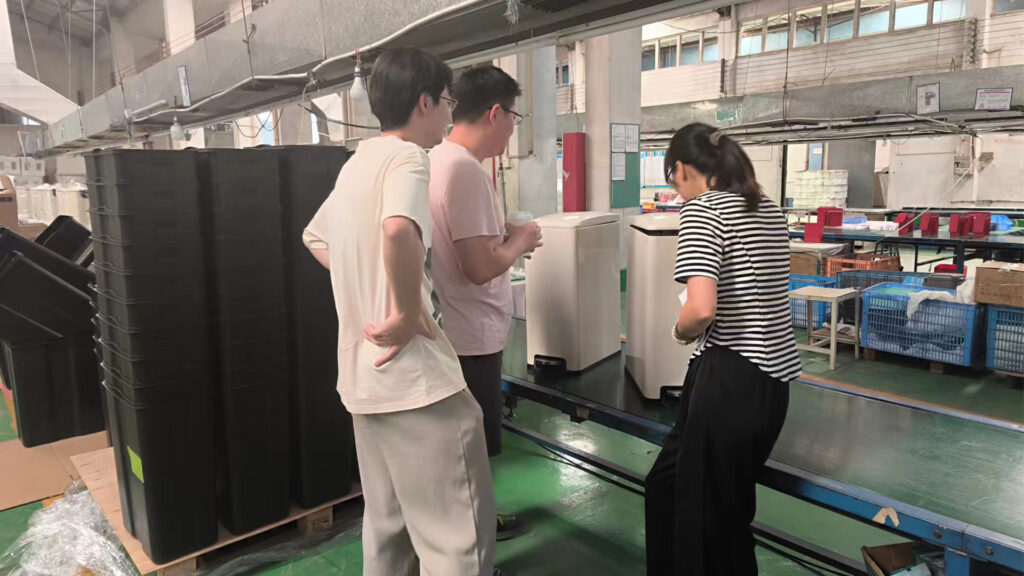
The best types of products to manufacture in China are those that benefit from scale, strong supplier ecosystems, and integrated production. This includes complex electronics and electromechanical products (like PCB assemblies, batteries, and smart devices), metal fabrication and CNC-machined parts, and plastic injection-moulded goods where tooling and unit costs are significantly lower.
China also excels in mass-produced consumer goods such as appliances, lighting, toys, and hardware, as well as products that combine multiple processes—like plastics, metals, and simple electronics—within one supply chain.
Emerging categories like EV components, energy storage systems, and certain medical devices are also strong. However, China is less ideal for highly regulated industries or very low-volume, handmade products where flexibility and compliance complexity outweigh cost advantages.
Manufacturing Products & Parts in China 2026
If the right steps are taken, your product idea will be easily seen in China. Whether you have production-ready specifications in detail and a partner with an experienced sourcing agent who can find a perfect match for a manufacturer able to negotiate the best terms and organise quality inspections before shipment, success depends on it.
How do you manufacture a new product in China?
Design, prototyping, sourcing, manufacturing, quality control, and shipping are all complex, technical, and unpredictable stages that OwlSourcing helps you navigate.
- everything.
- From beginning to end.
We turn your vision into something real, something precise, something you can actually launch. And we do it with the kind of efficiency that only comes from years of navigating this ecosystem without getting burned.
We customise the entire process to meet your objectives, whether you’re creating a new product or improving an existing line.
Simple, well-executed execution. For more information, Contact Us.
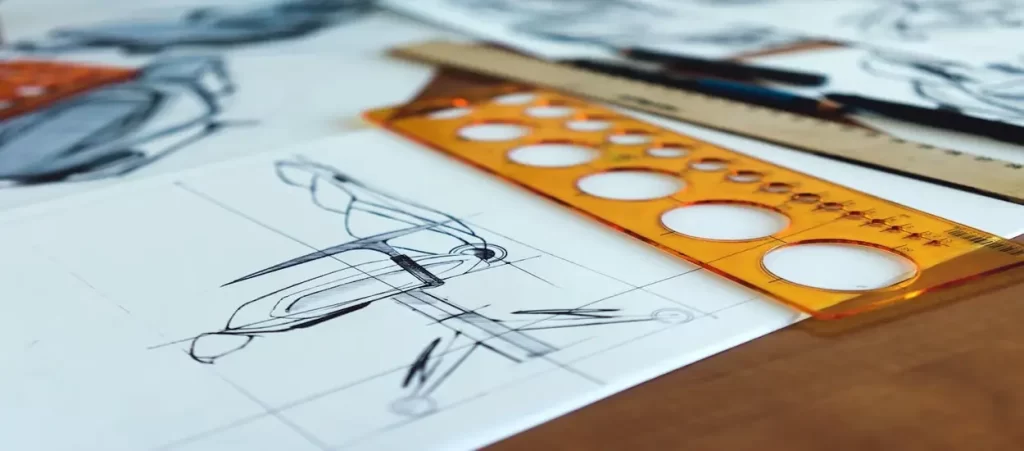
Step 1: Product Conceptualisation and Design
- Start with clear and comprehensive designs to identify potential issues and ensure market viability.
- Use CAD software for precise, 3D designs and prototyping services to test and refine the product.
- Prototyping bridges design and manufacturing, ensuring quality before full-scale production.
- Highlight the importance of custom product manufacturing in aligning the design with market needs.
Product Design and Prototyping with Chinese Factories
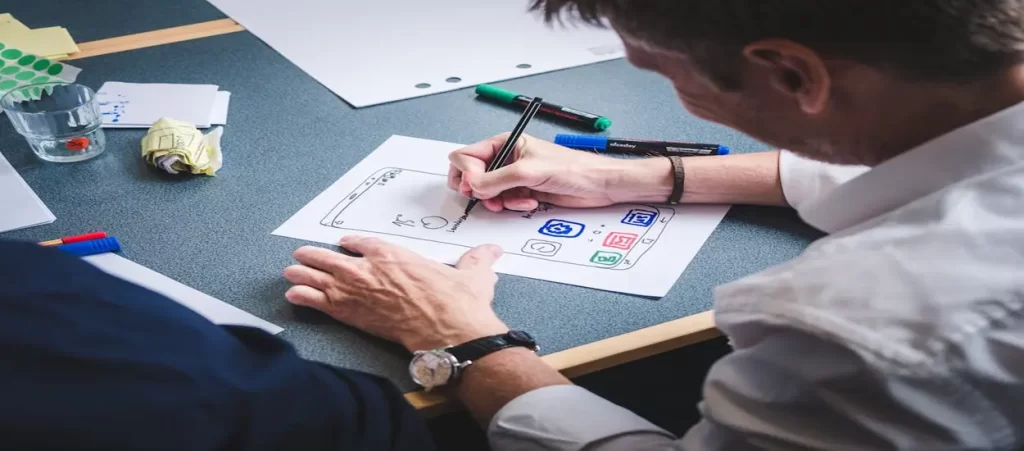
You must know how to make a prototype in China. Before you can start manufacturing in China, you’ll need a solid design and a working prototype.
Many manufacturers offer product development services that include prototyping. At this stage, work with the manufacturers to create and refine prototypes. Ensure that the prototype performs as expected in real-world scenarios.
It can reveal design flaws that weren’t observed in the concept stage. Don’t hesitate to iterate on the prototype to create a great product.
Step 2: Protecting Intellectual Property (Beyond the NDA)
In China, a standard Western Non-Disclosure Agreement (NDA) is practically unenforceable. To protect your product before sharing CAD files, you must execute an NNN Agreement:
-
Non-use: Prevents the factory from using your idea to compete with you.
-
Non-disclosure: Prevents them from leaking your design to their sub-suppliers.
-
Non-circumvention: Prevents them from selling directly to your customers.
Expert Tip: For an NNN to be valid in 2026, it must be governed by Chinese Law, written in Chinese, and include a specific “Liquidated Damages” clause that makes it cheaper for the factory to comply than to cheat.
The NPI Framework: From EVT to PVT
Successful hardware companies don’t just “make a prototype.” They follow a rigorous stage-gate process to ensure the design is manufacturable at scale.
| Phase | Name | Goal |
| EVT | Engineering Validation Test | Does the product work? (Breadboard/Rough prototypes) |
| DVT | Design Validation Test | Is it durable and compliant? (Final materials, FCC/CE testing) |
| PVT | Production Validation Test | Can the factory make 1,000 of these at the correct speed and quality? |
If you skip DFM (Design for Manufacturing), your factory will likely “guess” your tolerances, leading to assembly failures during mass production.
Understand China’s Regulatory Environment
Your product may face specific regulations depending on it.
- Early filing of patent and trademark applications is advisable since China is a first-to-file jurisdiction.
- Secure your intellectual property to stay ahead and avoid legal tangles.
- Beware of several potential traps, including delayed registration of IP and other hidden costs.
These rules might cover safety, materials, or environmental concerns. Knowing them early saves time and money.
Also, ensure your product meets all standards and Chinese export regulations. Be aware of any taxes, tariffs, or duties that may apply to your product. Working with local sourcing experts can help you avoid potential issues.
Step 3: Finding the Right Manufacturer in China

You must choose the manufacturer that is the best in China. It impacts your product’s quality, cost, and timing. Here are three effective methods to find a reliable manufacturer.
1) Hire a Sourcing Agent in China
2) Online Marketplaces
3) Trade Shows
How to Evaluate Manufacturers?
Check their experience and capabilities. Does the factory have a history of making products like yours? Specialisation matters. So, look for manufacturers who are experts in your product category. They should also have relevant certifications.
Also, check the factory’s location for shipping costs and delivery times.
Many wholesale markets in southern China are near significant ports. This proximity aids in efficient product exports.
In contract talks, outline every detail. Include pricing, lead times, quality control, and penalties for delays or defects. It will protect your interests and set clear expectations for both parties.
Step 4: Quality Control for Your New Products in China
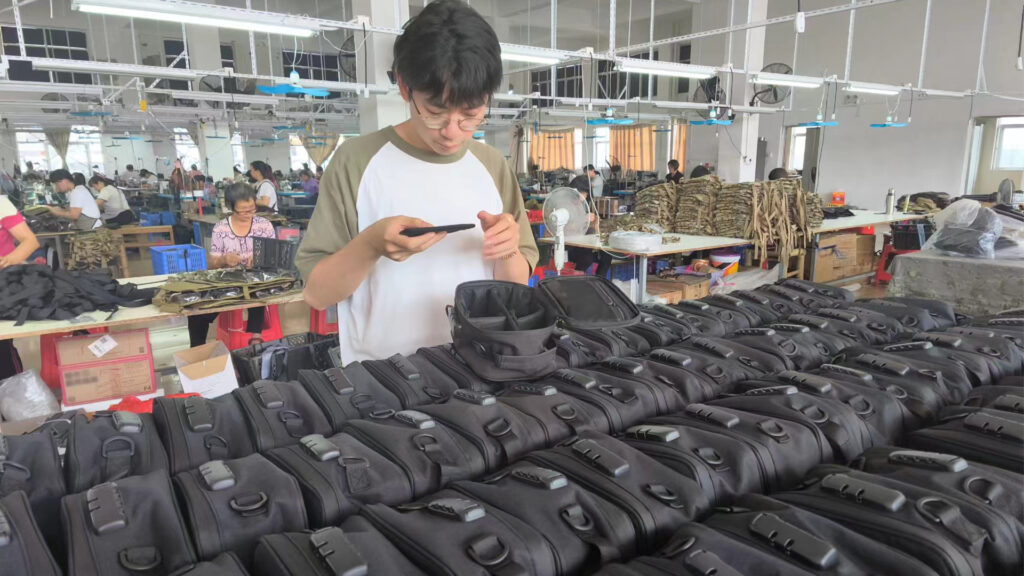
It is essential to ensure quality when manufacturing new products in China. Even if you choose a reliable manufacturer, issues can still arise during production. For accuracy, you should do quality control in China in the following three phases.
- Pre-production Quality Control: Always work with your manufacturer to establish quality standards.
- In-process Inspections: These include regular inspections during production to detect defects early.
- Post-production Inspections: Inspect the goods before shipping to confirm they meet your standards. It will save you from receiving defective or non-compliant products later on.
Or implement these technical milestones:
-
DFA/DFM Review: Before tooling begins, review the design to ensure it can be assembled without high defect rates.
-
In-Process Inspection (DUPRO): Check the first 20% of the production run. If the glue isn’t curing or the finish is off, you can stop the line before wasting the entire budget.
-
The Golden Sample: Never start mass production until you have a signed-off “Golden Sample” physically in your hands. This is your legal benchmark for quality.
Hire a reliable third-party quality inspection firm in China to perform these inspections.
- Provide the timeline for pre-production, in-production, and pre-shipping checks for quality assurance.
- Whether it is adherence to Chinese regulations or conformance with international standards, such as ISO certifications or CE marking, for any potential market entry issues that could arise,
- Set a good standard quality control procedure and eliminate various inspection communication barriers.
Step 5: Make a Sample with Your Supplier
- Elaborate on a prototype to see your supplier’s capability and re-develop the product.
- Use the benefits of the prototyping services to agree upon a design and quality.
- Use this phase to resolve problems and confirm custom product manufacturing needs.
Step 6: Negotiation of Terms [Financial Reality: The 30/70 Standard]
- Negotiate price, MOQs, lead times, and payment terms to reach a mutually viable agreement.
- Prepare overall contracts with specifications, quality parameters, timelines, and contingencies.
- Emphasise the insights relevant to industry experience in strengthening the negotiations.
In 2026, the industry standard for payment remains:
-
30% Deposit: To start sourcing raw materials and tooling.
-
70% Balance: Paid only after a third-party inspection confirms the goods meet your specifications.
Warning: Never pay the final 70% based on “photos of the boxes.” Once the money leaves your account, you have lost all leverage for rework or repairs.
Step 7: Manage Manufacturing and Communication
- Regular communication about manufacturing progress can be done through periodic reports and site visits.
- Be prepared for such risks as supply chain disruptions with contingency plans.
- Use clear channels to resolve any communication barriers.
Step 8: Managing Production Timelines and Costs
Image Source: Pixabay
Once production begins, managing your timelines and costs becomes critical. New product manufacturing in China can be fast-paced, but delays are not uncommon. Set realistic production timelines with your manufacturer.
But be prepared for delays due to holidays like the Chinese New Year, which can shut down factories for weeks.
We mentioned that manufacturing costs in China are usually lower. However, unexpected expenses can sometimes add up. So, track material costs, labour rates, and shipping fees to ensure you stay within budget.
Step 9: Shipping and Logistics: “Black Box” Strategy
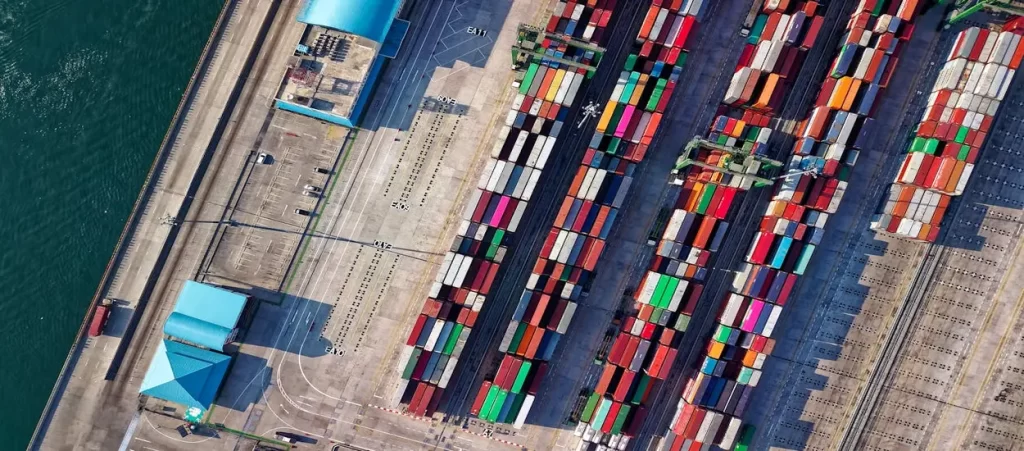
Some high-level importers use the “Black Box” Strategy:
-
Segmented Sourcing: Buy critical components (like a proprietary chip) from Supplier A, the casing from Supplier B, and have a third-party CM (Contract Manufacturer) do the final assembly.
-
The Result: No single factory in China knows exactly how your finished product is made or who your end customer is.
Don’t skip cargo insurance. It protects your investment from shipping losses. Check how to buy shipping insurance when shipping from China. Professional handling of logistics prevents problems and protects your business.
Customs Clearance: After choosing your shipping method, you must clear customs. It involves dealing with tariffs, duties, and regulations. It’s complex, and mistakes can cause delays. Consider working with a good customs broker.
Please refer to the following article for more information on customs clearance in China.
How Long Does it Take to Manufacture & Source Products
If initiating a product from scratch, then the whole process may take roughly 10-12 months. This timeline includes everything from developing the initial idea to shipping the finished product.
For more streamlined projects or readily available items, the timeframe can be significantly shorter.
Key Phases in the Manufacturing and Sourcing Process:
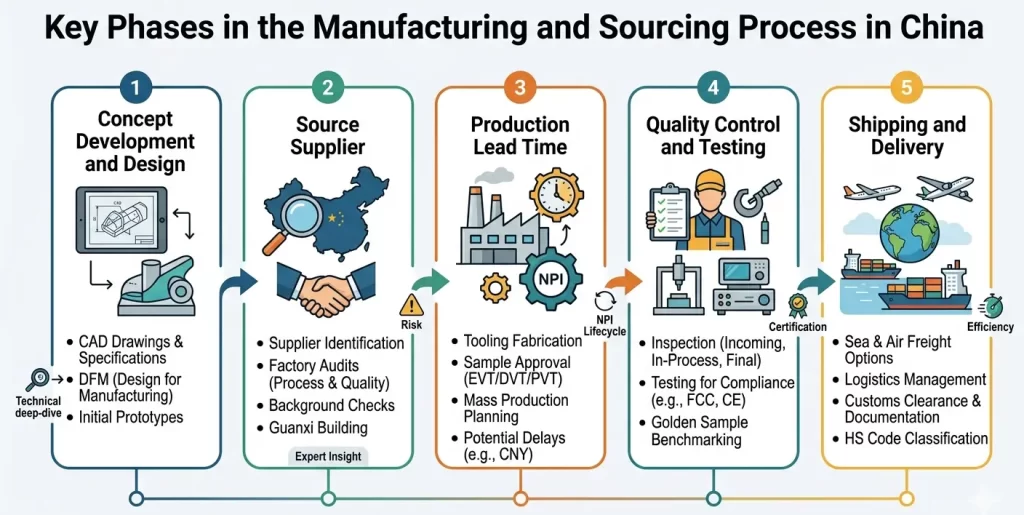
1. Concept Development and Design
This stage involves the fine-tuning of your product idea, creating the technical designs, and getting the concept ready for production.
2. Source Supplier
Sourcing the right supplier is paramount. For experienced sourcing agents, this can be hastened by their pre-established networks of suppliers.
3. Production Lead Time
Manufacturing timelines will depend on the product type and its complexity:
- Standard Products (Off-the-Shelf): For readily available items, the process can take as little as 7–30 days, including quality checks and packaging.
- Custom Products: These take longer because they involve design, prototyping, and testing.
- Design and Prototyping: Usually 3–8 weeks.
- Production: 15–60 days, depending on the complexity and size of the order.
4. Quality Control and Testing
Quality can be ensured in products by inspections and testing, which may take 2–5 days, though it might vary depending on the product category.
5. Shipping and Delivery
Shipping times depend upon the method of transport used:
- Air Freight: 5–10 days
- Sea Freight: 2–6 weeks
Average Manufacturing and Shipping Times in China
If starting with a new product, including sample production and sea freight, the whole process usually takes 3–5 months. This estimate may vary depending on the project’s complexity and scope.
Key Factors Affecting Timelines:
- Material Availability: Delays in sourcing raw materials or components can add weeks to the process.
- Supplier Reliability: Working with a reliable supplier or sourcing agent can help smooth the production process, reduce errors, and avoid costly delays.
- Seasonal Factors: Major holidays, like the Chinese New Year, can easily double timelines since they disrupt manufacturing schedules.
Appreciating this phase and all other challenges will keep the business informed to plan properly for their goods to arrive just in time.
If the products are custom or a project is rather complex, making sure everything goes smoothly and efficiently means working with a professional sourcing agent like Owlsourcing.
Common Mistakes to Avoid When Developing a Product in China
To succeed in developing a product in China, ensure:
- Transparent communication;
- Reliable contingency plans;
- Thorough attentiveness at every stage.
It’s essential to avoid:
1) Lack of Clear Communication
Language barriers or unclear instructions can lead to production errors.
You can use precise, detailed specifications. Also, hire a sourcing agent to ensure effective communication and prevent costly mistakes.
2) Poor Quality Control
Without proper quality checks in place, inconsistent product quality can result.
Set strict quality control protocols. Work with third-party quality inspectors to track production standards.
3) Counterfeiting
Counterfeiting is possible if you fail to protect your idea. Register your trademarks and patents in China. Also, sign NDAs with Chinese suppliers.
4) Rushing into Production
Skipping the prototyping phase can result in costly defects or product recalls. You can create and test a prototype before moving to mass production.
5) Hidden Costs and Misunderstood Contracts
Overlooking details in contracts can lead to hidden fees or unexpected charges. Your contracts must clearly outline costs. Include penalties for delays or defects.
Securing an “Open BOM” Strategy
A common “trap” for startups is letting the factory own the Bill of Materials (BOM). If your factory chooses all the sub-suppliers for the PCB, the plastic resin, and the packaging without sharing that data with you, they have “hostage” power over your pricing.
-
Requirement: Demand a fully transparent BOM.
-
Why: If your primary factory misbehaves, an Open BOM allows you to move production to a backup facility in weeks rather than months.
FAQs
Here, I would like to address frequently asked questions about manufacturing a new product in China.
1) How Do I Find a Genuine Manufacturer in China?
Finding a reliable manufacturer in China can be challenging. But a global supply chain provider simplifies this. They offer local knowledge and connections and can check manufacturers. It ensures you pick a factory that meets your product’s needs and quality standards.
2) How Do I Ensure High-Quality Production?
Set up strong checks on quality. Getting a sourcing agent can ensure that the manufacturer meets the necessary standards.
3) What Shipping Option Is Best for My Products?
Sea freight is cheaper for large shipments but slower. In contrast, air freight is faster for urgent items but more expensive. Choose a China shipping service based on your budget and schedule.
4) How Can I Protect My Intellectual Property?
You should register your trademarks and patents in China. Have manufacturers sign NDAs to protect your products’ designs and technology.
Read More:
- Top Ways to Find a Reliable Sourcing Agent in China
- Buying Product Samples from China
- How to Find Chinese Private Label Manufacturers
- Top Cities and Provinces for Sourcing in China
Final Thoughts!
Making your product in China opens up many options. Yet, it needs careful planning and choices. You must pick a reliable manufacturer and manage timelines and shipping. A sourcing agent can make this easier. They ensure quality, smooth production, and lower risks.
Want to begin production? Choose OwlSourcing. We’ll find a genuine manufacturer for you. Reach out to us today!